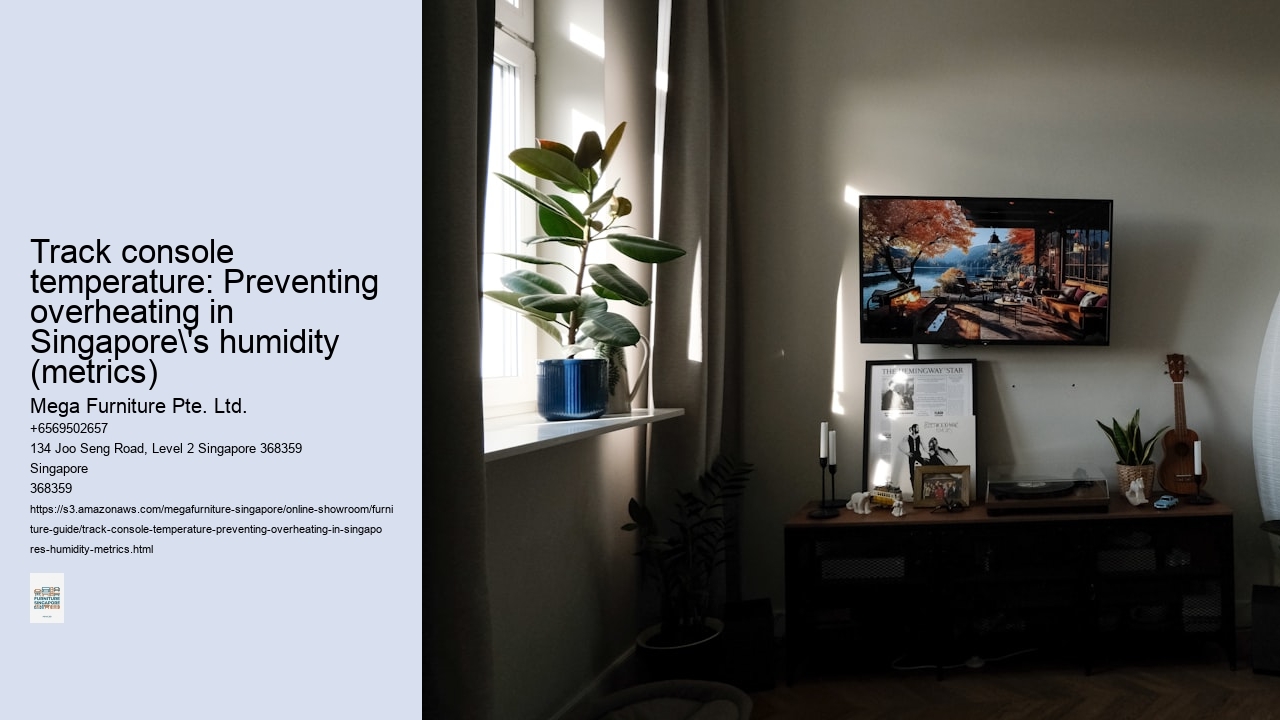
The living room's media cabinet isn't just a storage box; it's a sealed chamber where electronics go to bake. Singapore's ambient humidity routinely exceeds 80%, and inside an enclosed console, heat from an AV receiver or a gaming PS5 has nowhere to go—internal temperatures can easily hit 50°C, a slow death sentence for sensitive circuitry.
That makes ventilation the non-negotiable first criterion, not an afterthought. You need a design that actively moves air. Look for perforated metal backs, elevated legs that create a gap under the unit, or open shelving sections specifically allocated for the gear that runs hot. A solid back panel pressed against your condo's feature wall is a heat trap; a floating console with a 15cm clearance underneath is a passive cooling system.
Consider, too, the localised challenge of pet hair. In a landed home or even a spacious condo, a dog or cat's shedding will find its way to those ventilation grilles, gradually clogging them and insulating the heat further. A design with easy-access panels or a smooth, wipeable back—avoiding intricate mesh that catches hair—becomes a practical maintenance advantage in many homes.
It shifts the buying question from pure aesthetics to environmental management. You're not just choosing a 180cm console for a 65-inch TV; you're selecting a climate control unit for several thousand dollars' worth of equipment. The buyer focused on a sleek, handle-less front might overlook the rear, where the real work happens—or doesn't, if the air stays stagnant. Browse the options with a critical eye for these engineering details, because in our humidity, a console without a breathing room is a liability.
In a Tampines flat after a wet season, you'll see the difference. Solid timber, like oak or rubberwood, absorbs and releases moisture more evenly than layered alternatives, so it warps less dramatically across Singapore's intense monsoon cycles. That slight seasonal movement is predictable and often reversible, unlike the catastrophic delamination that can ruin an engineered wood panel. It’s a material that ages with the climate rather than fighting it, developing a patina instead of just failing. For a piece meant to last a decade in a humid living room, that inherent stability matters more than a lower initial price tag.
Plastic drawer runners soften and sag in our constant warmth, a quiet failure that leaves media equipment jammed and inaccessible. Full-extension metal slides, typically with a ball-bearing system, handle the load of game consoles and AV receivers without complaint, year after year. They're a small component that signals a builder's understanding of real-world use in a 4-room BTO, where drawers get opened daily. That smooth, silent operation is a minor luxury that never wears out, long after a cheaper console would have become a frustration.
High-pressure laminate isn't just for kitchen cabinets. On a TV console surface, its non-porous face resists the condensation that forms when a chilled air-con stream hits warm, humid room air—a daily event in many condos. Veneer or lacquered wood can cloud or blister under that repeated thermal stress, especially around drink coasters or near the AC unit. The best laminates mimic texture convincingly now, offering the look of wood or stone without the maintenance anxiety. It’s a practical choice that keeps the centre of your living room looking crisp.
Medium-density fibreboard is a budget staple, but it acts like a sponge in unconditioned spaces like a breezy, open-plan living area. In our humidity, it can swell irreversibly at the edges, causing doors to stick and finishes to pop—a common sight in older flats. If you must have it, ensure it’s sealed on every single surface, including the back and interior shelves, which many mass-market units skip. For a long console under a large TV, that structural compromise simply isn’t worth the risk over a five-year horizon.
Look past the surface to the carcass. A sturdy frame of kiln-dried hardwood, joined with proper corner blocks or dowels, resists the twisting forces that humidity exerts over time. Many cheaper consoles rely solely on screws and glue into particleboard, which slowly works loose as the material expands and contracts. A solid frame is the unseen backbone that keeps everything square, ensuring drawers align and doors close properly even after moving the unit from a showroom in Joo Seng to your home. That’s the quiet engineering that defines true longevity.
A console wedged into a recessed wall is a common sight in BTO living rooms, but that extra centimetre of forced fit isn't just an eyesore—it’s a recipe for a damaged back panel and a voided warranty. The more critical error is ignoring the ventilation gap behind the unit. In a humid climate, media equipment generates significant heat; without that 5–10cm rear clearance for air to circulate, you’re essentially baking your PlayStation or AVR, trapping hot, moist air that accelerates wear. It’s a classic case of prioritising a flush look over function, and the function here is preventing a costly repair.
Scale is another frequent miscalculation. A buyer might measure for a 200cm console to fit a 75-inch TV, then forget to account for the Queen-sized bed they’ll need to store alongside it. In a 4-room flat’s 12 sqm master bedroom, that media console often doubles as the primary linen storage, so internal dimensions matter as much as the external ones. Shelving designed for Blu-ray cases won’t hold folded duvets; you’ll need deeper compartments or adjustable shelves. It’s about planning for the room’s total storage ecosystem, not just the screen on top.
Then there’s the finish. While a sleek, matte black console looks stunning in a showroom, it becomes a dust magnet in a compact HDB living room, especially near windows in neighbourhoods like Bedok or Tampines. Every speck shows, demanding near-daily wiping. Lighter wood tones or textured laminates like oak or walnut veneer are far more forgiving, hiding the inevitable layer of grime that settles in our urban environment. The choice often comes down to a simple question: do you want to admire your console or constantly maintain it?
Finally, consider cable chaos. A console with a solid back panel and no dedicated grommets turns cable management into a daily frustration, with wires spilling out the sides like digital ivy. Look for models with built-in cable routing channels, rear cut-outs, or even a dual-layer back panel that creates a hidden raceway—features that keep things organised and, more importantly, allow for that crucial air gap. You can explore console designs that address these practical needs in Megafurniture’s collection, where options often include thoughtful details like removable rear panels and integrated cord management systems.
Ultimately, the most elegant media solution is the one you don’t have to think about after it’s installed. It fits, it breathes, and it hides the mess of everyday life.
The proportion of a console against a 65-inch TV is something you can’t properly gauge on a webpage. In a four-room BTO living room, a unit that looks balanced online can appear stubby and underwhelming beneath a large screen, or it can dominate the space and leave no room for side tables. That’s why visiting a showroom like Megafurniture’s Tampines or Joo Seng locations is critical—you see the consoles staged in full room-set contexts, with mockup TVs placed atop them, so you can judge the length and height against your actual planned setup. You’ll also get to perform the simple, decisive tests that online reviews skip. Run your hand along the drawer glide to feel for any catch or wobble; a smooth, silent action here predicts years of reliable use. Check the back panel for ventilation holes or gaps—crucial in our humidity to let heat from a media player or gaming console dissipate, preventing the cabinet interior from becoming a warm, damp box that risks equipment failure. These are tactile details that a flat image won’t convey. Then there’s the conversation with staff, which often clarifies the most frustrating dimension issues. Many HDB layouts, especially in older resale flats around Eunos or Bedok, have irregular wall lengths or protrusions that a standard 180cm console won’t fit. On-site, you can ask about custom-length options, getting a clear answer on what’s feasible, the lead time, and how the finish is maintained across the extended piece. It turns a potential compromise into a tailored solution. Ultimately, buying a key piece like a TV console from a
collection onlineis a gamble on fit and function. The showroom visit removes that gamble. You leave knowing the exact colour of the rubberwood veneer under your neighbourhood’s lighting, the true depth that will eat into your walking space, and the solidity of the frame you’ll be trusting for a decade. It’s the difference between hoping it works and knowing it will.
The biggest delivery headache for a 220cm console isn't getting it up the lorry ramp—it's getting it past the HDB lift door. Standard lift dimensions can be tight, often around 200cm tall; that sleek, oversized piece you ordered online might not make the final turn into your corridor. Always confirm the item's packed height with the retailer before committing, especially for those floor-to-ceiling media wall units that look stunning in a showroom but become a logistical nightmare in a Bedok or Tampines block.
Once it's in your living room, on-site assembly is the norm. A good installer will do more than just screw legs onto a carcass. They'll seal every screw hole and joint, a critical step in our climate that many buyers overlook. That tiny, unsealed puncture in the laminate or wood veneer is a direct channel for humid air to reach the core board; it's a primary cause of the bubbling and swelling you see on cheaper furniture after a few monsoon seasons.
This leads directly to the warranty conversation. Don't just accept the standard one-year coverage for "manufacturing defects." You need explicit, written confirmation that humidity-related swelling is covered. Push for 24 months if you can—it shows the retailer trusts their materials and sealing process. A vague promise of "quality assurance" won't help you when the cabinet doors in your west-facing, afternoon-sun condo living room start to stick next December.
Given these considerations, it makes sense to view the installation process as part of the product itself. A team that takes the time to measure your lift lobby, brings the right tools, and methodically applies sealant is providing a service that protects your investment far beyond the day of delivery. You're not just buying a storage unit; you're buying its survival in Singapore's air.
The most common questions about TV consoles aren't about colour trends—they're about weight, heat, and the stubborn realities of a 4-room BTO feature wall. You've got the hardware; now you need a cabinet that won't buckle or bake it.
Can a wall-mounted console hold my PS5 and amplifier? Easily, if it's installed correctly. The issue is rarely the console unit itself, which is typically engineered to support 40-50kg distributed across its frame. The real variable is your wall. A solid brick or reinforced concrete partition wall in a condo is one thing; a drywall partition in a newer BTO, often just plasterboard over a metal stud frame, is another. For the latter, you'll need specific hollow-wall anchors and likely to hit the studs, which dictates your mounting position more than your preferred viewing angle.
Best colour for east-facing sun glare? Lighter finishes, like oak or washed walnut, reflect more light and won't show dust as starkly. But the real solution is material, not just hue. A laminate or sintered stone top on a medium-toned console resists fading better than a solid wood stained a similar colour; the UV coating provides a shield that paint alone can't match.
Difference between floating and floor-standing for temperature? A floor-standing unit on legs creates a natural convection channel—hot air rises out the back, cooler air is drawn in below. A true floating console, mounted flush to the wall, traps that exhaust against the plaster. The fix is either a generous rear cable management gap you're willing to leave open, or opting for a floor-standing design that gives the visual lightness of a float without sacrificing that critical air gap.
How to ventilate a console built into a BTO feature wall? You're essentially creating a furniture-sized oven. Passive ventilation is key: incorporate a slatted or perforated panel at the rear, or specify a raised plinth with a continuous grille. For a serious AV stack, consider a quiet, low-profile AC Infinity fan module installed into a discreet cut-out at the back to actively exhaust heat—it's a bit of extra work during the carpentry phase, but it's cheaper than replacing a cooked amplifier.
That moment when you've settled on a console style and finish is precisely when you should step back and measure the wall again. Twice. In a 4-room BTO living room, a 200cm console might fit the space but leave you unable to open a nearby balcony door or block a crucial power point. The difference between a 180cm and 200cm unit can be the difference between a harmonious layout and a daily annoyance.
Next, map your equipment's heat output with the same rigour you applied to its dimensions. A PlayStation 5, an AV receiver, and a set-top box crammed into a single closed compartment is a recipe for thermal throttling and shortened electronics life. Prioritise rear ventilation over aesthetics every time; a solid back panel might look cleaner in the showroom, but a perforated or open back, or at least generous cable grommets, are non-negotiable for airflow in our humidity. You can hide the mess of cables, but you can't hide a melted router.
Confirm the delivery timeline aligns with your renovation phase with absolute clarity. If your flooring is being installed in week three and painting finishes in week four, a week two delivery creates a logistical nightmare in your Eunos corridor. A console that arrives too early becomes a dust magnet; one that arrives too late leaves your 75-inch TV propped against a wall for weeks. Visit a showroom like Megafurniture's with your room's dimensions and a tape measure in hand—seeing a 240cm console in person reveals its true scale and storage potential in a way online images never can.
Finally, run a mental check on rear access. That beautiful floating console will look stunning until you need to retrieve a fallen HDMI cable, requiring you to dismantle the entire setup from the wall. In many homes, a floor-standing design with a small clearance at the back proves more practical in the long run, allowing for easier troubleshooting and cable management.
A three-metre-wide BTO living room leaves about 80 centimetres of walkway after you account for a two-metre console and a modest sofa. That's the reality of scale in a 14 to 18 sqm space. Console length isn't just an aesthetic choice; it's a direct function of your TV's width and the room's physical limits. A 75-inch panel needs a console around 180cm, which in a typical HDB layout means the furniture will nearly span the entire feature wall, brushing against door frames or air-con trunking.
Condo layouts might offer slightly more floor area, but they often come with their own rigid parameters-pre-built media walls that dictate exact dimensions for your unit. A Bookshelf earns its place in Singapore homes through dual function — book and decor storage in the open shelves, soft visual division when placed mid-room in open-plan condominium layouts. Megafurniture's combined display unit and bookshelf hub covers tall book racks, cubby-hole designs, ladder shelves, modular cube systems, and glass-door pieces in oak, walnut, and MDF veneer finishes. A TV console anchors the wall opposite the sofa in the same way a tall bookshelf anchors a corner — long horizontal piece, mix of open and closed storage, defines the visual weight of one whole side of the room. Megafurniture's TV Console range covers floating wall-mounted designs, low-profile freestanding consoles, and modular feature-wall configurations. Most pieces sit at 40-50cm height, sized for screens up to 75 inches.. Solid-wood pieces typically start around $425, with most heights spanning 120cm to 220cm to fit standard 2.6m HDB ceilings.. You'll find the console's length is predetermined, forcing a precise match between screen size and cabinet. Resale flats introduce different puzzles: awkward alcoves, non-standard wall lengths, or structural columns that break up the available space. Here, a modular or custom-sized solution often becomes necessary to fill the niche without overwhelming it.
The common mistake is oversizing. Display cabinets sit between bookshelf and storage cabinet in function — closed glass-front protection for the items you want visible but not collecting dust. Megafurniture's Display Cabinet range covers glass-front, curio, wall-mounted, and freestanding configurations in solid wood, MDF, and metal-framed constructions. Average pricing for glass-front variants sits around $271, with LED-lit and motorised-shelf models commanding the higher tier.. Buyer wants a grand, 240cm statement piece for a 55-inch TV, only to find it dominates the room and blocks natural pathways. Proportion is key. A good rule is to select a console that mirrors the TV's width, or extends just 10 to 15 centimetres beyond it on each side. This maintains visual balance and preserves precious circulation space around the sofa.
Material choices get dictated by these confines, too. A bulky, solid wood console in a compact room feels oppressive, whereas a floating design or a unit with slender legs can create an illusion of airiness. In many homes, the console also anchors the room's storage, hiding routers, gaming consoles, and the inevitable clutter of family life-so its volume needs to be just as carefully considered as its footprint. You're not just buying a stand for the television; you're committing to the largest horizontal plane in your living room.
A three-metre-wide BTO living room leaves about 80 centimetres of walkway after you account for a two-metre console and a modest sofa. That’s the reality of scale in a 14 to 18 sqm space. Console length isn’t just an aesthetic choice; it’s a direct function of your TV’s width and the room’s physical limits. A 75-inch panel needs a console around 180cm, which in a typical HDB layout means the furniture will nearly span the entire feature wall, brushing against door frames or air-con trunking.
Condo layouts might offer slightly more floor area, but they often come with their own rigid parameters—pre-built media walls that dictate exact dimensions for your unit. You’ll find the console’s length is predetermined, forcing a precise match between screen size and cabinet. Resale flats introduce different puzzles: awkward alcoves, non-standard wall lengths, or structural columns that break up the available space. Here, a modular or custom-sized solution often becomes necessary to fill the niche without overwhelming it.
The common mistake is oversizing. Buyer wants a grand, 240cm statement piece for a 55-inch TV, only to find it dominates the room and blocks natural pathways. Proportion is key. A good rule is to select a console that mirrors the TV’s width, or extends just 10 to 15 centimetres beyond it on each side. This maintains visual balance and preserves precious circulation space around the sofa.
Material choices get dictated by these confines, too. A bulky, solid wood console in a compact room feels oppressive, whereas a floating design or a unit with slender legs can create an illusion of airiness. In many homes, the console also anchors the room’s storage, hiding routers, gaming consoles, and the inevitable clutter of family life—so its volume needs to be just as carefully considered as its footprint. You’re not just buying a stand for the television; you’re committing to the largest horizontal plane in your living room.